


[Read Time - 5 minutes]
Do you NEED to hire a second shooter to be a successful wedding photographer?
Short answer - Perhaps.
The longer and more detailed answer - Let’s discuss.
Now, I’m pretty confident that most well-established wedding photographers would say, “Yes, of course, you need a second shooter,” buuuut I’m not like most well-established wedding photographers.
For the first half of my two-decade career, I shot hundreds of wedding completely by myself with no second shooter and was very happy, if I do say so myself.
I shot big weddings and really big weddings and small weddings and even smaller weddings.
So when did I decide to change, or the better question is, WHY did I change?
For me, it was a decision of quality and logistics.
I have always been more than happy to shoot a wedding by myself and I will continue to do so.
Shooting the prep wasn’t a problem. Shooting the reception was never a problem, and I never really had a problem with the ceremony, but in some instances, I wanted more.
Outdoor Weddings
At an outdoor wedding, I can roam free! I move from side to side and get every possible angle from behind the guests with no trouble whatsoever.
Sure, I’m running (literally) from one side to the other, sometimes on my belly, far back and close up. That’s ME and my desire to shoot the wedding so it LOOKS like there are three photographers working.
I like that because I know what I’m getting before I even look at the photos.
The only challenge with outdoor ceremonies is the limited time to get all the shots I want (they’re typically short). So when someone asks how I got so many different shots in a short period of time, I can use my favorite Forrest Gump quote, “I was running!”
Indoor Weddings
Indoor or church weddings are traditionally longer, but access is significantly more restricted...and I can’t run.
During the ceremony, for example, I’ll get shots “down Broadway,” as I call it, which means shooting right down the center of the aisle from somewhere in the back half of the church (usually on sticks). This is common.
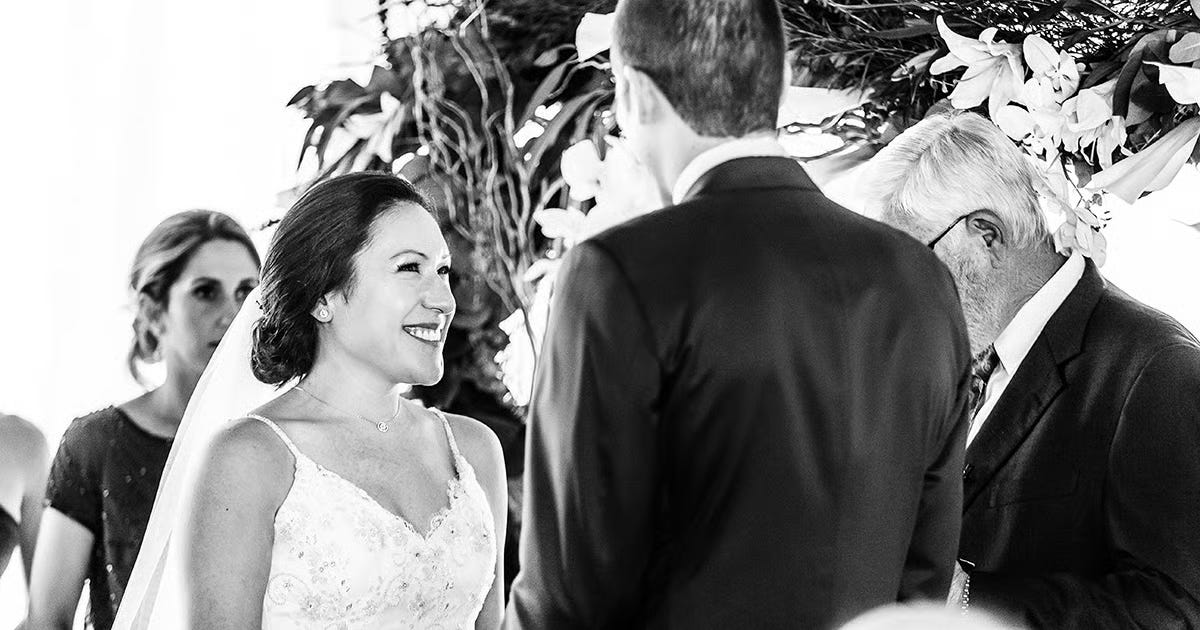
I also like getting a shot of the bride looking into the eyes of the groom when they’ll facing each other during his vows to her, as well as the same shot of the groom looking at his soon-to-be wife during her vows to him.
This requires me to move quickly but quietly from one side to the other.
I’ll also get a shot from the balcony if there is one, and a variety of angles in between.
I CAN get all of these angles on my own and have for years, but I still have to hustle. This is where a second shooter becomes really valuable.
I typically position them on the groom’s side of the church, looking towards the bride, gazing lovingly at her husband-to-be.
At this angle, they can also get the bridesmaids, the cute flower girls, the parents in the front (very tough for me to shoot from the back) and anything else creative they can squeeze in while still focusing on the bride.
This leaves me time to focus on everything else (groom, guys, Broadway and balcony) and NOT have to worry about the most important person in the room, the bride.
Once I saw the value of this opportunity, I could shoot more, different, and even better shots, especially at more restrictive venues like churches. And anything I can do to get better photos for my couples is always a huge plus!
The Reception
The second bonus, which was my biggest surprise, is help with the first dance. This typically comes at the beginning of the reception when the couple first arrives.
I would do my thing with my trusty 24-70mm, getting the wides and medium shots, and my second shooter would use a 70-200mm to get some great close-ups - something I could never shoot before.
Once the first dance is over, the rest of the evening is all mine, and I let my second take the rest of the night off.
Of course, every photographer has a different way of working with their second shooter, but that raises a good question, How do you treat your fellow assitant photographers?
I’m not fond of the word “assistant.” I prefer to use “associate photographer,” and I also prefer to treat those who shoot with me as partners, not subordinates.
Perhaps it’s just me, but when you’re working WITH someone rather than FOR someone, you tend to care more - about your work and who you’re working for.
I want my associates to care about both.
Now, I will add a word of caution from one professional to another.
At the end of the day, YOU are ultimately responsible for the photos delivered to your couple. If your associate doesn’t get the shots you need, that’s on you.
In addition to helping your associate know what to shoot, you should also guide them on how to shoot it to your standards.
Do your due diligence and communicate with your associate so you both know what to expect from each other. Like anything else, communication is the key to success.
So, CAN you be a profitable wedding photographer without using a second shooter? Of course, you can.
Is it better to have a second (or third) photographer with you? I suppose that depends on the logistics of the venues, the scope of the day, and your personal work ethic, but in short, there are certainly more advantages to having some help than disadvantages.
As with many things in running your business, the decision is yours, but when you, as a professional photographer, can set aside your need to be the star of the show and focus on delivering the very best for your client, you become TRUE professional.
I’ve written more about becoming a second shooter in Issue #15, and you are more than welcome to check it out.

“Teamwork requires some sacrifice up front; people who work as a team have to put the collective needs of the group ahead of their individual interests.”
– Patrick Lencioni
Whether you use a second shooter or not is just one of the little parts of the “inner game of wedding photography,”
THIS is what I write about each week in this newsletter.
If you’d like to be notified each Sunday morning when a new issue is released, click that beautiful blue subscribe button (and thank you in advance). I also share valuable tips and tales in Notes all week.
If you know someone who’d love this juicy insider information, click this equally beautiful and benevolent button here.
If you’re starting as a photographer and haven’t quite figured out how to handle the hundreds, or even thousands, of photos from an event, I’ve created something to help you.
It’s a guide to help you process your wedding in one week, and it’s a system I’ve used for over 25 years and still use today. Don’t spend weeks processing and miss out on The Glow. This system will help you get your photos to your client, make them happy and make you look like the professional you want to be.
"... my second shooter would use a 70-200mm to get some great close-ups"
Sitting up in the balcony sniping shots of the bride when she doesn't even know I'm there sounds way more fun than all that running around you're doing down there on the floor. 😁
Anybody who has a chance to work with you as a partner should feel lucky.